Fill a Valid Illinois Ptax 340 Form
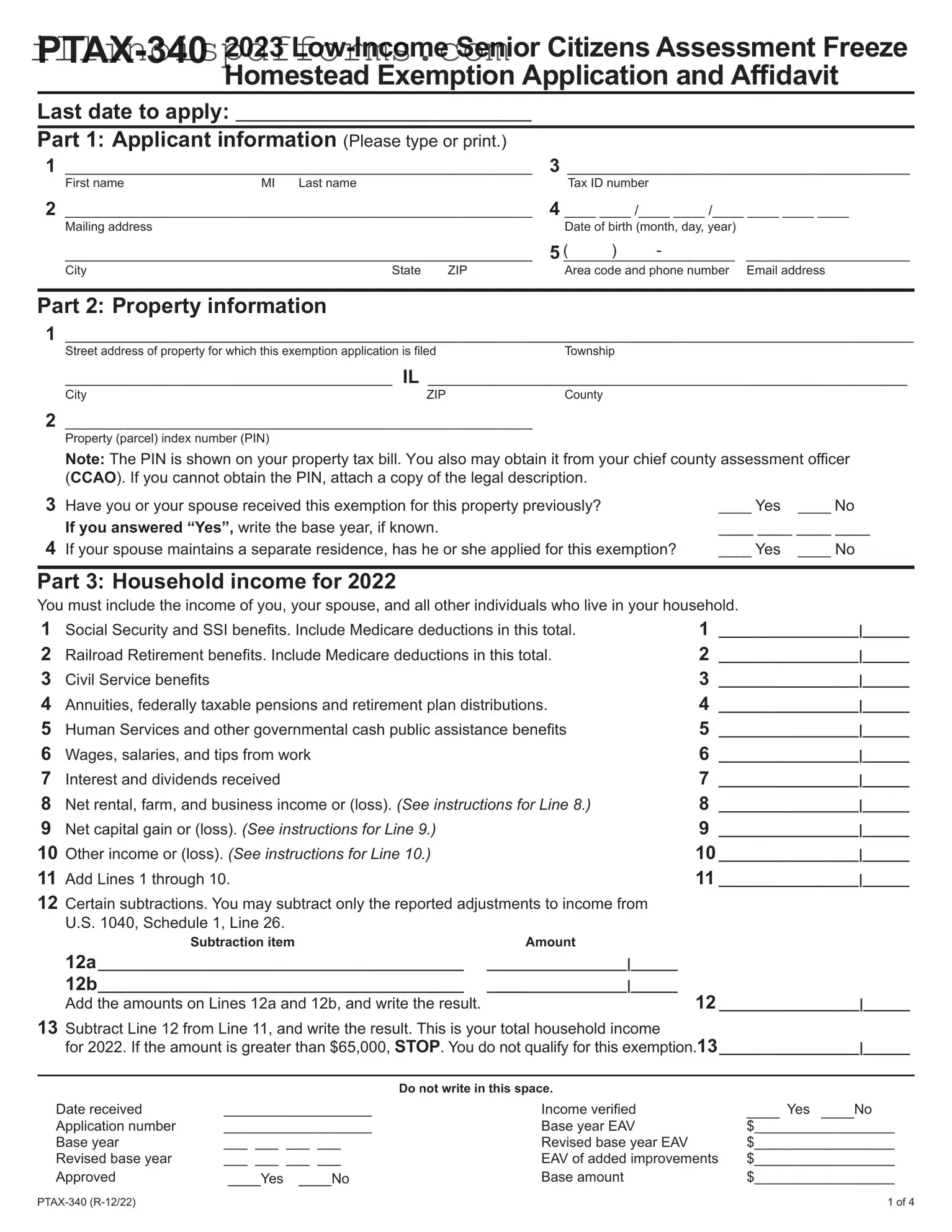
The Illinois PTAX-340 form serves as a vital tool for senior citizens seeking to benefit from the Senior Citizens Assessment Freeze Homestead Exemption. This exemption is designed to help eligible homeowners maintain their property tax assessments at a stable level, effectively freezing the equalized assessed value (EAV) of their homes. To qualify, applicants must be at least 65 years old and have a total household income of $65,000 or less. The form is divided into several key sections, including applicant information, property details, household income, and an affidavit. Each section requires specific information, such as the applicant's name, mailing address, and date of birth, as well as details about the property for which the exemption is being sought. Additionally, applicants must provide a comprehensive account of their household income for the previous year, ensuring that all sources of income are accurately reported. The affidavit section confirms the applicant's eligibility and includes declarations regarding property ownership and residency status. Completing the PTAX-340 form accurately and submitting it by the designated deadline is crucial for seniors wishing to take advantage of this significant tax relief opportunity.
Example - Illinois Ptax 340 Form

Last date to apply: ______________________________________
Part 1: Applicant information (Please type or print.)
1 |
____________________________________________________________ |
3 ____________________________________________ |
|||||||
|
First name |
MI |
Last name |
|
|
Tax ID number |
|
|
|
2 |
____________________________________________________________ |
4 |
____ ____ /____ ____ /____ ____ ____ ____ |
||||||
|
Mailing address |
|
|
|
|
Date of birth (month, day, year) |
|
||
|
____________________________________________________________ |
5 |
( |
) |
- |
_____________________ |
|||
|
______________________ |
||||||||
|
City |
|
State |
ZIP |
|
Area code and phone number |
Email address |
||
Part 2: Property information
1_____________________________________________________________________________________________________________
Street address of property for which this exemption application is filedTownship
__________________________________________ |
IL ______________________________________________________________ |
|
City |
ZIP |
County |
2____________________________________________________________
Property (parcel) index number (PIN)
Note: The PIN is shown on your property tax bill. You also may obtain it from your chief county assessment officer
(CCAO). If you cannot obtain the PIN, attach a copy of the legal description.
3 |
Have you or your spouse received this exemption for this property previously? |
____ Yes |
____ No |
|
If you answered “Yes”, write the base year, if known. |
____ ____ ____ ____ |
|
4 |
If your spouse maintains a separate residence, has he or she applied for this exemption? |
____ Yes |
____ No |
Part 3: Household income for 2022
You must include the income of you, your spouse, and all other individuals who live in your household.
1 |
Social Security and SSI benefits. Include Medicare deductions in this total. |
1 |
__________________|______ |
2 |
Railroad Retirement benefits. Include Medicare deductions in this total. |
2 |
__________________|______ |
3 |
Civil Service benefits |
3 |
__________________|______ |
4 |
Annuities, federally taxable pensions and retirement plan distributions. |
4 |
__________________|______ |
5 |
Human Services and other governmental cash public assistance benefits |
5 |
__________________|______ |
6 |
Wages, salaries, and tips from work |
6 |
__________________|______ |
7 |
Interest and dividends received |
7 |
__________________|______ |
8 |
Net rental, farm, and business income or (loss). (See instructions for Line 8.) |
8 |
__________________|______ |
9 |
Net capital gain or (loss). (See instructions for Line 9.) |
9 |
__________________|______ |
10 |
Other income or (loss). (See instructions for Line 10.) |
10 __________________|______ |
|
11 |
Add Lines 1 through 10. |
11 __________________|______ |
|
12Certain subtractions. You may subtract only the reported adjustments to income from U.S. 1040, Schedule 1, Line 26.
Subtraction item |
Amount |
12a_______________________________________________ __________________|______ |
|
12b_______________________________________________ __________________|______ |
|
Add the amounts on Lines 12a and 12b, and write the result. |
12 __________________|______ |
13Subtract Line 12 from Line 11, and write the result. This is your total household income
for 2022. If the amount is greater than $65,000, STOP. You do not qualify for this exemption.13__________________|______
|
|
Do not write in this space. |
|
Date received |
___________________ |
Income verified |
____ Yes ____No |
Application number |
___________________ |
Base year EAV |
$__________________ |
Base year |
___ ___ ___ ___ |
Revised base year EAV |
$__________________ |
Revised base year |
___ ___ ___ ___ |
EAV of added improvements |
$__________________ |
Approved |
____Yes ____No |
Base amount |
$__________________ |
1 of 4 |

Part 4: Affidavit
Sworn under oath, I state the following:
1(Mark the statement that applies.)
On January 1, 2023, the property identified in Part 2, Line 1, was improved with a permanent structure a ____ that I used as my principal residence.
b ____ for which I received this exemption previously and is either unoccupied or used as my spouse’s principal residence. I am now a resident of a facility licensed under the Assisted Living and Shared Housing Act, Nursing Home Care Act, ID/DD (intellectually disabled/developmentally disabled) Community Care Act, or Specialized Mental Health Rehabilitation Act of 2013.
_______________________________________ |
_________________________________________________ |
Name of facility |
Mailing address |
2(Mark the statement that applies.)
On January 1, 2023, I
a ____ was the owner of record of the property identified in Part 2, Line 1.
b ____ had a legal or equitable interest by a written instrument in the property listed in Part 2, Line 1.
c ____ had a leasehold interest in the property identified in Part 2, Line 1, that was used as a
3I am liable for paying real property taxes on the property identified in Part 2, Line 1.
Note: If I have not received this exemption for this property previously, I also met the eligibility requirements listed in Part 4, Lines 1, 2, and 3 for this property on January 1, 2022.
4(Mark the statement that applies.)
a ____ In 2023, I am, or will be, 65 years of age or older.
b ____ In 2023, my spouse, who died in 2023, would have been 65 years of age or older. (Complete the following information.)
_____________________________________________ |
__________________________________________________ |
Deceased spouse’s name |
Tax ID number |
____ ____ /____ ____ /____ ____ ____ ____ |
____ ____ /____ ____ /____ ____ ____ ____ |
Date of birth (month, day, year) |
Date of death (month, day, year) |
5The property identified in Part 2, Line 1, is the only property for which I am applying for a
6The amount reported in Part 3, Line 13, of this form includes the income of my spouse and all persons living in my household and the total household income for 2022 is $65,000 or less.
7On January 1, 2023, the following individuals also used the property identified in Part 2, Line 1, for their principal residence.
My spouse is included if he or she used the property as his or her principal dwelling place on January 1, 2023. The total income of all individuals and my spouse (regardless of his or her principal residence) are included in Part 3. (Attach an
additional sheet if necessary.)
First and last name |
Tax ID number |
a __________________________________________________ |
__________________________________________________ |
b __________________________________________________ |
__________________________________________________ |
8(Mark the statement that applies.) On January 1, 2023, I was
a ____ single, widow(er), or divorced. b ____ married and living together. c ____ married, but not living together.
My spouse’s name and address is _____________________________________________________________________________
First nameMILast name
_____________________________________________________________________________________________________________
Street Address |
City |
State |
ZIP |
Under penalties of perjury, I state that, to the best of my knowledge, the information contained in this affidavit is true, correct, and complete.
_______________________________________ ____ ____/____ ____/____ ____ ____ ____
Signature of applicant |
Date (month, day, year) |
Note: The CCAO may conduct an audit to verify that the taxpayer is eligible to receive this exemption.
Mail your completed Form |
If you have any questions, please call: |
|
_________________Co. Chief County Assessment Officer |
(_________)__________________________________________ |
|
|
— |
|
_______________________________________________________ |
Last date to apply ___ ___/___ ___/___ ___ ___ ___ |
|
Mailing address |
Month Day |
Year |
____________________________________IL _________________
CityZIP
This form is authorized in accordance with the Illinois Property Tax Code. Disclosure of this information is required. Failure to provide information may result in this form not being processed and may result in a penalty.
2 of 4
Printed by the authority of the state of

Form
What is the
The
Exemption (35 ILCS
citizen, to have your home’s equalized assessed value (EAV) “frozen” at a base year value and prevent or limit any increase due to inflation. The base year generally is the year before the year you first qualify and apply for the exemption. For example, if you first qualify and
apply in 2023, your property’s EAV will be “frozen” at the 2022 EAV.
The amount of the exemption is the difference between your base
year EAV and your current year EAV. For Cook County only, the
amount of the exemption is the difference between your base year
EAV and your current year EAV or $2,000, whichever is greater.
Freezing your property’s EAV does not mean that your property taxes will not increase, however. Other factors also affect your tax bill. For
example, your tax bill could increase if the tax rate, which is based on the amount of revenues taxing districts request, increases. Your EAV and tax bill may also increase if you add improvements to your home.
However, if your home’s EAV decreases in the future, you will benefit
from any reduction.
Who is eligible?
The
you will pay in 2024), are listed below.
•You will be 65 or older during 2023.
•Your total household income in 2022 was $65,000 or less.
•On January 1, 2022, and January 1, 2023, you
–used the property as your principal place of residence,
–owned the property, or had a legal or equitable interest in the property as evidenced by a written instrument, or had a leasehold interest in the property used as a
–were liable for the payment of property taxes.
You do not qualify for this exemption if your property is assessed under the mobile home privilege tax.
Surviving spouse – Even if you are not 65 or older during 2023, you are eligible for this exemption for 2023 (and possibly 2022) if your spouse died in 2023 and would have met all of the qualifications.
Residents in a health facility – Even if you did not use the property as your principal place of residence on January 1, 2023, you qualify for this exemption if you are a resident of a facility licensed under the Assisted Living and Shared Housing Act, Nursing Home Care Act, ID/DD (intellectually disabled/developmentally disabled) Community Care Act, or Specialized Mental Health Rehabilitation Act of 2013 and you meet all other requirements, have received this exemption previously, and your property is either unoccupied or is occupied by your spouse.
Residents of cooperatives – If you are a resident of a cooperative apartment building or cooperative
What is a household?
A household includes you, your spouse, and all other persons who used your residence as a principal dwelling place on January 1, 2023.
What is included in household income?
Household income includes your income, your spouse’s income, and the income of all individuals living in the household. Examples of
income that must be included in your household income are listed below. (For specific questions, see Part 3 on Page 4.)
•alimony or maintenance received
•annuities and other pensions
•Black Lung benefits
•business income
•capital gains
•cash assistance from the Illinois Department of Human Services and other governmental cash public assistance
•cash winnings from such sources as raffles and lotteries
•Civil Service benefits
•damages awarded in a lawsuit for nonphysical injury or sickness (for example, age discrimination or injury to reputation)
•dividends
•farm income
•Illinois Income Tax refund (only if you received Form
•interest
•interest received on life insurance policies
•long term care insurance (federally taxable portion only)
•lump sum Social Security payments
•miscellaneous income, such as from rummage sales, recycling aluminum, or baby sitting
•military retirement pay based on age or length of service
•monthly insurance benefits
•pension and IRA benefits (federally taxable portion only)
•Railroad Retirement benefits (including Medicare deductions)
•rental income
•Social Security income (including Medicare deductions)
•Supplemental Security Income (SSI) benefits
•all unemployment compensation
•wages, salaries, and tips from work
•Workers’ Compensation Act income
•Workers’ Occupational Diseases Act income
What is not included in household income?
Some examples of income that are not included in household income
are listed below. (For specific income questions, see Part 3 on
Page 4.)
•cash gifts
•child support payments
•COBRA subsidy payments
•damages awarded in a lawsuit for a physical personal injury or sickness
•Energy Assistance payments
•federal income tax refunds
•IRA’s “rolled over” into other retirement accounts, unless “rolled over” into a Roth IRA
•lump sums from inheritances
•lump sums from insurance policies
•money borrowed against a life insurance policy or from any financial institution
•reverse mortgage payments
•spousal impoverishment payments
•stipends from Foster Parent and Foster Grandparent programs
•Veterans’ benefits
What if I have a net operating loss or capital loss carryover from a previous year?
You cannot include any carryover of net operating loss or capital loss from a previous year. You can include only a net operating loss or capital loss that occurred in 2022.
Will my information remain confidential?
All information received from your application is confidential and may be used only for official purposes.
When must I file?
File Form
exemption.
Note: The CCAO may require additional documentation
(i.e., birth certificates, tax returns) to verify the information in this
application.
What if I need additional assistance?
If you have questions about this form, please contact your CCAO, also known as the supervisor of assessments, or county assessor, at the address and phone number printed at the bottom of Page 2.
3 of 4 |

Form
Part 1: Applicant information
Lines 1 through 5 – Type or print the requested information.
Part 2: Property information
Lines 1 and 2 – Identify the property for which this application is filed.
Lines 3 and 4 – Answer the questions by marking an “X” next to your statement. If you answered “Yes” to the question on Line 3 and you know the base year, write it in the space provided.
Part 3: Household income for 2022
“Income” for this exemption means 2022 federal adjusted gross income, plus certain items subtracted from or not included in your federal adjusted gross income (320 ILCS 25/3.07). These include
loss carryovers, capital loss carryovers, and Social Security benefits. Income also includes public assistance payments from
a governmental agency, SSI, and certain taxes paid. These
The amounts written on each line must include the 2022 income for you, your spouse, and all the other individuals living in the household.
As an alternative income valuation, a homeowner who is enrolled in any of the following programs may be presumed to have household income that does not exceed the maximum income limitation for that tax year: Aid to the Aged, Blind or Disabled (AABD) Program or the Supplemental Nutrition Assistance Program (SNAP), both of which are administered by the Department of Human Services; the Low Income Home Energy Assistance Program (LIHEAP), which is administered by the Department of Commerce and Economic
Opportunity; The Benefit Access program, which is administered by
the Department on Aging; and the Senior Citizens Real Estate Tax Deferral Program.
Line 1 – Social Security and Supplemental Security Income (SSI) benefits
Write the total amount of retirement, disability, or survivor’s benefits (including Medicare deductions) the entire household received from
the Social Security Administration (shown on Form
3 or use box 5 only if there is a reduction of benefits). You also must
include any Supplemental Security Income (SSI) the entire household received and any benefits to dependent children in the household.
Do not include reimbursements under Medicare/Medicaid for medical expenses.
Note: The amount deducted for Medicare is already included in the amount in box 3 of Form
Line 2 – Railroad Retirement benefits
Write the total amount of retirement, disability, or survivor’s benefits (including Medicare deductions) the entire household received under the Railroad Retirement Act (shown on Forms
Line 3 – Civil Service benefits
Write the total amount of retirement, disability, or survivor’s benefits the entire household received under any Civil Service retirement plan (shown on Form
Line 4 – Annuities and other retirement income
Write the total amount of income the entire household received as an annuity from any annuity, endowment, life insurance contract, or similar contract or agreement (shown on Form
Line 5 – Human Services and other governmental cash public assistance benefits
Write the total amount of Human Services and other governmental cash public assistance benefits the entire household received. If the first two digits of any member’s Human Services case number are the
same as any of those in the following list, you must include the total
amount of any of these benefits on Line 5.
01 |
aged |
04 and 06 temporary assistance to |
02 |
blind |
needy families (TANF) |
03 |
disabled |
07 general assistance |
To determine the total amount of the household benefits, multiply the
monthly amount each person received by 12. You must adjust your figures accordingly if anyone in the household did not receive 12
equal checks during this period.
Food stamps and medical assistance benefits anyone in the house- hold may have received are not considered income and should not be added to your total income.
Line 6 – Wages, salaries, and tips from work
Write the total amount of wages, salaries, and tips from work for every household member (shown in box 1 of Form
Line 7 – Interest and dividends received
Write the total amount of interest and dividends the entire household received from all sources, including any government sources (shown on Forms
Line 8 – Net rental, farm, and business income or (loss)
Write the total amount of net income or loss from rental, farm, business sources, etc., the entire household received, as allowed on
U.S. 1040, Schedule 1, Lines 3, 5, and 6. You cannot use any net operating loss (NOL) carryover in figuring income.
Line 9 – Net capital gain or (loss)
Write the total amount of taxable capital gain or loss the entire household received in 2022, as allowed on U.S. 1040, Line 7 and
U.S. 1040, Schedule 1, Line 4. You cannot use a net capital loss carryover in figuring income.
Line 10 – Other income or (loss)
Write the total amount of other income or loss not included in Lines 1 through 9, that is included in federal adjusted gross income, such as alimony received, unemployment compensation, taxes withheld from oil or gas well royalties. You cannot use any net operating loss
(NOL) carryover in figuring income.
Line 11 – Add Lines 1 through 10.
Line 12 – Subtractions
You may subtract only the reported adjustments to income totaled on U.S. 1040, Schedule 1, Line 26. For example:
IRA deduction |
educator expenses |
Archer MSA deduction |
tuition and fees |
student loan interest |
domestic production |
deduction |
activities deduction |
jury duty pay you gave to your |
deductible part of |
employer |
|
penalty on early withdrawal of |
|
savings |
insurance deduction |
|
health savings account |
and qualified plans |
deduction |
alimony or maintenance paid |
moving expenses |
Line 13 – Total household income
Subtract Line 12 from Line 11. If this amount is greater than $65,000, you do not qualify for this exemption. See Page 3.
Part 4: Affidavit
Lines 1 through 4 – Mark the item that applies. Read the affidavit
carefully. The statements must apply.
Line 7 – Write the names and tax identification numbers of the
individuals, other than yourself, who used the property for their principal residence on January 1, 2023. Attach an additional sheet if necessary.
Line 8 – Follow the instructions on the form. If your spouse does not reside at this property, be sure to write his or her name and address.
Note: You must sign your Form
your CCAO. Return your completed Form
office or mail it to the address printed on the bottom of Page 2.
4 of 4 |
Document Breakdown
| Fact Name | Description |
|---|---|
| Form Purpose | The PTAX-340 form is used to apply for the Senior Citizens Assessment Freeze Homestead Exemption in Illinois. |
| Eligibility Age | Applicants must be 65 years of age or older during the year they apply to qualify for the exemption. |
| Income Limit | The total household income must be $65,000 or less for the year prior to application to qualify. |
| Governing Law | This form is governed by the Illinois Property Tax Code, specifically 35 ILCS 200/15-172. |
| Application Deadline | Applications must be submitted by a specific date each year, as indicated on the form. |
| Property Requirements | The property for which the exemption is sought must be the applicant's principal residence. |
| Previous Exemptions | If the applicant or their spouse has previously received this exemption, it must be noted on the application. |
| Income Verification | The Chief County Assessment Officer may require documentation to verify income and eligibility. |
| Filing Frequency | Applicants must file the PTAX-340 form annually to continue receiving the exemption. |
| Confidentiality | All information provided in the application is confidential and used solely for official purposes. |
Create More PDFs
Illinois Business Income Tax - Nonbusiness income or loss and its allocation requires completion of Schedule NB, ensuring the proper treatment of such income for tax purposes.
For those navigating their property transactions, understanding the importance of a clear Real Estate Purchase Agreement is paramount. This document serves not only as a blueprint for the sale but also as a protective measure for both parties. For more information, visit the comprehensive guide to Real Estate Purchase Agreement essentials.
State of Illinois Unclaimed Property - Guidance on preparing a paper copy report when electronic reporting is not an option.